Monday, February 9, 2009

Painting the Galmi Hospital December 4-7

High School Outreach Trip to Galmi
December 4-7, 2008

Sahel Academy organizes several outreach trips a year for high school students to become involved in community service projects which share the love of Jesus with others. Last year, Tim and I helped chaperone one of the trips that went to Inates, a Tuareg community near the boarder to Mali. On that trip, we helped assemble 60 desks for the primary school in Inates, and we also had an opportunity to share The God Story movie in the Tuareg language (Tamajek).

This year, I helped lead a team of 7 high school students along with another adult. We were invited by Galmi Hospital to re-paint the inside of outpatient building and also do some other odd jobs around the mission station. Galmi hospital is a small (120 bed) but very significant SIM missionary hospital about 7 ½ hours drive east of Niamey. People come from all over the region (even from neighbouring Nigeria) to get quality medical care.

Galmi is also well-known in Niger for its tasty onions. I’ve even heard it said that the MAGGI company in Niger uses Galmi onions in their bouillon cubes!

The trip to Galmi went as planned but much of the way we had to dodge large potholes in the broken pavement AND several bright green chameleons that were crossing the road! I’m so glad that I didn’t have to drive; thank God for Mr. Potratz.


The area just outside of the town Dogondoutchi has some really unique geological features.

Galmi hospital and compound is a green oasis surrounded by scrubby Sahel (semi-desert), thanks to the foresight of missionaries years ago who planted many trees and gardens.

I particularly took a liking to this unusual plant that people call “desert Christmas cactus” since it seems to flower around December.


Mr. Borody (on the right) gave us a tour of the hospital. We’re standing on the foundation for the future Operating Room and wing.

On Friday, we did a bunch of odd and end jobs. The boys emptied the water from the pool and washed the walls. This proved to be an all day affair! They came across several obstacles along the way: the drain at the bottom of the pool was plugged and never was able to be cleared, the pool pump was unreliable and stopped working, and bailing the pool by buckets is harder than you think! To top it off, they finished the afternoon by helping trim some branches that were covering the Galmi wall sign along the road. But we girls didn’t sympathize with their hardships because it looked like they were having WAY TOO MUCH FUN!


The girls had a lighter workload, but with its own share of frustrations. We helped program 4 new American cash registers (we became experts at entering and re-entering codes in the machines!) and also help clean the dusty mailroom of the Galmi hospital office.


Mr. Potratz (SIM computer technician) and his oldest son had other responsibilities over the weekend. Their job was to help troubleshoot computer problems and install computer software in the office.

The girls and I took a break that morning and visited the Galmi day school for the missionary kids. This year, there are only 3 kids (all from one family). Mrs. Borody is their very animated and “motherly” teacher. The kids were busy making Christmas decorations (icicles). It brought back special memories for one of the girls on our trip who had attended the school in her early elementary years. It also reminded me of the small mission school in Cameroun where I attended until the end of grade 4.


Just beware! Scorpions and cobras hide in rock piles and under front steps at Galmi. Cobras have been known to crawl into the school house if the screen door is not properly latched!

Friday night, we had the dirty job of sweeping the walls of the outpatient room (lots of dust collects everywhere in Niger) and washing off as much "grime" as possible.

We were ravenous and tired by 9:30pm, but still we managed to have a family dinner around the table (African peanut sauce “à la Christine”). The students also surprised me with a special birthday “cookie” and a little gift.
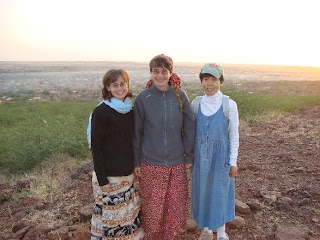
Saturday morning came way too early! Especially for Susana and I! We woke up before 6am to join Yoko and Lawrence (the 2 ladies in the photo with me) on a walk up a hill overlooking Galmi for a time of prayer together.

Our first job was to paint the top half of the walls white. That took all morning!


We had a lot of fun with the blue!


But it wasn’t easy making a straight line without any masking tape to guide our brushes!

Mission accomplished!


On the drive back to Niamey, we passed a lot of overloaded vehicles and people on the road. People were travelling back to their home villages to celebrate the Muslim holiday of Tabaski (or Id al Ada) on Dec 8 and 9. Packed alongside the people and bags were sheep, calmly awaiting their fate the next day. This Muslim holiday of excessive feasting commemorates the sacrifice Abraham made in obedience to God. In one village, we passed several men carrying large legs of recently butchered beef on their head (most likely in preparation for all the feasting).


We came across this accident not long after it happened. Thank God this wasn’t us! Many accidents on the “highways” here occur due to speeding, carelessness, and unsafe passing practices.
Just around lunch time, our van hit a large pothole which dislodged some wires in the electrical wiring of the vehicle and gave us a short. We lost engine power and rolled to a stop in front of a large tree. (This was no coincidence. The countryside behind us and ahead of us had very few shade trees and none close to the road that could shelter a van-load of students! This was definitely a God-planned event!) So while Mr. Potratz and his son worked on the problem and got it fixed, the rest of us got lunch ready. We arrived safely back to Niamey covered with “battle” scars of white and blue paint.

NEEDS• The hospital is about 60 years old and is in need of constant repairs and renovations. A portion of the foundation for the OR wing was poured a couple of years ago, but since then it has sat unfinished. An elderly American builder was out helping for a few weeks, but so far there is no one who has come forward to help oversee completing the rest of the construction. Can you help? Do you know someone who is willing and able to help?
Visit the amazing Galmi Hospital website! http://galmi.org/

Friday, December 19, 2008

Great links related to Christine's work in Niger

Tim and I enjoy writing about our time here in Niger. Unfortunately, there never seems to be enough time to write about everything and download the pictures we'd like to share with you.

So, while you wait for the next installment of articles from Christine and Tim, I (Christine) want to share with you some interesting stories, fun pictures and excellent websites that I have come across through friends/colleagues here in Niger.

For a starter, you might want to begin at the Sahel Academy website. Browse around and learn more about my school and the community that makes it so special.
http://www.sahelacademy.com/home.html

Don't forget to click on the link to the "Sahelian", the school on-line newspaper. You'll find some recent articles about the "Sahel Games" held in November (our version of the Olympics or Track and Field Day), the softball tournament in October that brings expats to Niamey from the neighbouring countries, and the story behind the construction of our new library building (media centre) over the summer. If you want to know what makes Sahel Academy a truly unique school, read about the graduating class of 2008. My favourite picture is a "Where's Waldo" photo of math teacher Ben Stam on top of a humungous baobab tree. Scroll down to read the article called "God's Provision for Sahel's Math Teacher" posted in April 2008. http://www.sahelacademy.com/sahelian/

On the "Sahelian" webpage, you can find links to past and present staff. There is also a link to our Mattimoe website.
You will find Anisa Blomquist's blog very interesting. She was my neighbour before Tim and I moved houses (you'll find some pictures of Snowy and Missy if you scroll down some). She has some recent entries about the grade 3/4 drama (I watched it and enjoyed pumpkin pie afterwards), the Student Council fundraiser evening called "Bella Notte" (an evening for the kids to dress up formally), great pictures of the "Sahel Games" and an excellent overview of the many construction projects that happened over the summer at Sahel. There's even a picture of my French room being gutted and tiled and re-painted.
Bob (high school History and Science teacher) and Lois Gillespie (Computer teacher) also have a great website. The article called "Bridge Building" just about sums up the reason for our work here in Niger. And if you're wondering how computer technology can be used to bless others, read Randy (SIM computer technician) and Wanda's website.

If you're interested in botany and horticulture, here is a link to the Niamey Gardening Club. http://www.plantsahel.org/page/Niamey+Gardening+Club I attended one of their meetings last year and enjoyed meeting other expats interested in gardening in the Sahel region. Although I would enjoy being a member of this club, I have chosen to spend my energies and free-time in other areas. What makes the Niamey Gardening Club interesting is that they're putting together an encyclopedia of plants found in the Sahel region of West Africa. The site provides pictures and information about trees, flowers, vegetables, fruits, herbs, and plants in the Sahel. http://www.plantsahel.org/

Another activity Tim and I would like to do more often (if it weren't for other committments on Saturday afternoons) is to join the Hash House Harriers club for a walk/jog in the fields and sand and rocks outside Niamey. The club is made up mostly of francophone expats who enjoy exercise and the outdoors. We went last January with some friends of ours. They have a very detailed blog of their weekly outtings if that interests you. http://hashniamey.blogspot.com/ Come and join us for a hike in Niger!

Monday, December 1, 2008

Hippo Watching

Do you have the courage it takes to look into the face of the most dangerous animal in Niger?

The animal that kills more humans in Africa that any other animal? If so, then join me on a potentially perilous adventure up the Niger River for a closer look at hippos in the wild.


In October, a number of friends and I (Christine) took a pirogue ride (canoe ride) up the Niger River. The 7 of us along with our guide had this entire motorized pirogue all to ourselves during the 3-hour trip! Complete with cushioned reclining seats! Come along for the ride!


We leave around 9:30am during the cooler part of the day. It’s quite pleasant on the river, especially with the covered roof to protect us from the hot sun.


HIPPO! Our first hippo sighting is less than 5 minutes into our trip, right next to the bridge only a few metres from where men are washing clothes!


Apparently, this hippo is frequently seen around the bridge and seems quite accustomed to having people around (or is it the other way around that people are used to having the hippo nearby).

We continue up-stream. Garden plots line the edge of the river. We wave to farmers working in their gardens and women and children washing along the banks of the river. The kids excitedly jump up and down in the water and wave back at us.


The banks of the Niger River are an oasis in the midst of the dry Sahel and encroaching desert. Tall grass grows along the banks and is cut for hay to feed livestock.


Another type of long “grass” growing at the edge of the river is actually rice that will be harvested in late November. The “scare-crow” in the rice paddy is not to scare crows, but rather to keep hippos from raiding the fields for food during their nightly “snack attacks”.


A few kilometres up-stream, we see the Presidential palace grounds up on a hill. Next, we come to the dam which helps to control the water level in dry season. The water pump station for the city is located here (actually, only a 15 minute walk from our present house). At the moment, the water level is very high so our boat can go right over the dam. In low water season, boats need to go through the little set of locks.


Fishermen congregate just below the dam to cast their nets from their little canoes. I never quite understand how they can manoeuvre a canoe so easily while standing up! And here I was always taught to stay sitting (or kneeling) in a canoe for stability!

Further upstream, we pass by a herd of cows grazing on one side of the riverbank and a large flock of egrets (or herons) lined up along the other side the riverbank and in the trees.


At the halfway point, our guide points us to the eating and breeding grounds of another herd of hippos. We sit quietly in the pirogue hoping to get another glimpse of the dangerous beast (“underwater mines” as Tim likens them to).

Phhoosh! The sound of a hippo surfacing for breath. There are two hippos this time, but they don’t stay at the surface for long before they disappear out of sight.

“Just be careful,” our guide warned, “if you ever hear 3 loud blows of a hippo surfacing for breath. That means the hippo is angry and is ready to charge you!”

Sunday, November 30, 2008

Human encounters

People in Africa – what are they like?

One of my (Tim) personal quests here in Niger is to understand the culture here, how do people think, why do they do what they do.
That is an especially challenging and even dangerous thing to discuss, but very interesting. We show you 2 dimensional photos but the full image – well I will try to share a little bit although obviously this question really warrants writing a book to do it some justice.

One of the fellows in this photo at right is a guy I know, I work with him, we are funding a couple of his projects. He is not just some stranger that I snapped a photo, he is a friend and associate. He came from a nomadic and muslim background, but he is today a Christian and works in development to help his fellow man.

People in general often figure that they know themselves well, they know who they are and their neighbours, how untrue – once you spend some time in another culture then you see things in your own culture that you never really knew, or not well.

Asking the question “what is African culture like” also begs the question “who are we” or “who am I”.
Everyone has their own personality of course, and some attributes are genetic, but there is a lot that we might consider common sense or common to “regular” people, and yet they are not universal but rather specific to your culture or your group of people. There are also universal or absolute values that we can find through all cultures, attributes common to all humankind, yet these values express themselves differently and have different boundaries.

Stories help make a point:
I am reminded of a visit I made once to a village where we work helping locals in nutrition and safe water amongst other things. In customary fashion we sat down and had tea with the local officials. We chatted for quite awhile with the head of the military there, le Commandant, a tough gritty fellow overseeing a dangerous job as we are in the dangerous zone near the border and near rebel and bandit activity (this town was months later invaded by rebels and the military overtaken).

After discussion for quite awhile, a man entered our compound and greeted us. He was not with our staff or a familiar face, he was just visiting. The visitor was dressed from head to foot in a pink flowing outfit. The military chief gave his goodbyes to us, and then walked out with the visitor, walking hand and hand with him slowly and chatting along the way. If two men were walking casually hand and hand down the street in any town in Canada with one dressed mostly in pink, that might raise a few eyebrows, but here in the African context it is of course different. Here brothers and close friends hold hands, it is like a hand shake that is simply extended in time, and also to mention that the colour pink has absolutely no symbolism different than say red or orange, it’s just another colour.
Actually a man and a woman would generally not hold hands in public here even if married, that would be morally questionable by some, but a man will frequently hold hands with another man he knows well and may walk hand in hand. It always takes us Westerners some time to get used to that, actually we don’t get used to it.

The big point from this story though is not the holding hands; it is the “common sense” of Africans to greet everyone and anyone, an extroverted culture. If you are a person and people see you, they will greet you, it just what everyone does. Even more so for those who are from the nomadic tribes it seems, maybe that comes from being more rural and more dispersed. When you are greeted by a Tuareg it will take some time to complete it as he will ask you about 8 questions (how’s the health? the wife? The heat? The sleep? The …) There is no one alone unless they are trying to be that way. This of course is different in western big cities where people are often alone and generally you don’t greet people you don’t already know (and often walk past people that you do know).

Christine remembers well a faux pas (goof up) of hers – she entered a taxi and sat down, and didn’t greet the other passengers (the taxis are private cars that operate like free lance buses – they fill up with people and the driver sets the route.) Christine got critiqued and chewed out by the other passengers because she didn’t greet all of them! One can be rude without knowing it! But she learned her lesson.

Canadians pride themselves as being very polite, even thinking themselves as superior in politeness and highly valuing this, and some dare to call themselves friendly (‘friendly Manitoba’). But despite that Canadians are only really polite within their own definition; they are not as polite as they think. If you would “cut and paste” them into Africa they would be considered somewhat rude. What is rude? Rude, by African culture, is to not greet anyone within close proximity. So for instance to walk into an office you work, if you pass anyone’s desk and did not greet them, you are snubbing them.

Unfortunately in Niger the idea of “forming a line” has not caught on, which is frustrating for us who know the obviously benefits of order and taking turns.
Most Nigeriens will not recognize a line and most will not sporadically form a line when there is a need. There is always the chaotic scrambling with pushing and aggressive behaviour to get your turn.

I’ve learned that in Canada the people have learned to “buy into” efficiency by agreeing to a first-come-first-served concept whenever there is a group of people waiting for something. If you see a line of people in front of what you want, you agree to join the back of it.

A perfect example is the 4 way stop. Christine mentioned to me once that Niamey needs some 4 way stops. However culturally this cannot work. A 4 way stop means you have looked to see who arrived before you and you wait for them to go first – that is strange and even laughable in this culture. Laughable because you would be waiting forever or until you are alone as the others will all rush into the intersection and honk and squeeze their way through! Ah the joys of driving. Actually the occasional person may notice your plight and take pity on you and stop traffic to wave you through. Which really involves other cultural traits! one of which is vigilantism.

It is well known that in Niger if a guard sees an intruder trying to break in, they will whistle to call in the neighbouring guards, and then they will capture the intruder and then … call the police? … ask questions?... no- they will beat and kill the intruder on the spot and then burn or dispose of the body. Ahh – nasty! I’ve seen this already once by chance, a man was getting beaten to death beside a mosque by a vigilante mob, one can presume an intruder (thief). This is the “common sense” here, community vigilantism, people taking the law into their own hands and issuing a punishment. No judges or lawyers present of course. This is due in part to a lack of confidence and lack of presence of police and the courts.

Nigeriens are generally honest and trust-worthy in matters of money and with regards to stealing, at least no less than Canadians, but the boundaries and definition of this are not exactly the same. To steal or not to steal? It is more complicated that you might think. An awful lot of Canadians out there would swear that they never steal and yet their computer software and music they are using was never purchased by them! So when does the definition of stealing start and end – at least in the serious sense of it?

When in a new culture you try things out and observe, willing to lose out a little if necessary at least to learn something. One thing is with change and verbal agreements. If I go to a crowded market and buy something there for 800 CFA francs ($2) and give the guy a 5000 F bill, he will likely say – I’ll go get some change. And off he goes with his wares and then he is out of sight deep in the crowd. Note that the average person in Niger earns less than 5000 F per day, and so this is no small peanuts. The thought of course crosses your mind that “some guy I’ve never met before just took my 5000 bill and disappeared, without leaving anything behind - is this person really coming back?”.
Many minutes may go by, and you wonder, hmmm, am I waiting for nothing? However the merchant will always come back and give you the correct change and off you go. Honouring a verbal agreement is culturally very important here, and so it is really the dignity attached to it that has force.
So although person x may look for ways to cheat and even steal, he will not breach a verbal agreement. Canada is a “writing” society, Niger is more verbal, and so verbal agreements have more weight with people here than say in Canada. In many ways a verbal agreement in Niger has more weight than a written agreement, even though it is harder to prove something verbal, but they are taken with great seriousness.

These are just some snippets, I could go on and on, but I won’t, and so to wrap up: There is beauty and ugliness in every culture, but each one different, and through this it magnifies the nature of our human condition.
There is the goodness there, the image of God in us that occasionally shines through and which is rooted in compassionate love, and in which collectively each culture adopts some of that goodness as normative. Then there is the fallen nature of mankind, the sin and selfishness that is rooted the absence of love, and which each culture adopts some of that and then puts these “bad” aspects as normative and acceptable.
The morality that Jesus calls us to, especially in the Sermon on the Mount in the Bible, is a new culture that embraces all goodness. The new culture is like no other and so naturally counter cultural to every human culture yet not in the same ways to each. It is a lofty goal that is not attained but nevertheless set out before us. Particularly the counter-cultural aspects are the hardest to follow, as it is always easy to follow a crowd. In this Jesus calls us to two things, one: to choose to seek and live out a life of goodness that is counter-cultural; 2) accepting his offer of forgiveness and reconciliation along the way as we fail.

Keeping the Zoo

Every morning, the first thing the zookeeper (Christine) does before eating breakfast herself is feed the “starving” animals. Snowy, the young feline, gets a small scoop of dry cat food mixed with some water. Snowy gets special treatment as an orphaned kitten and is allowed to eat indoors safe from the new dog. Although Snowy is already close to 5 months old, she still likes to crawl onto “momma’s” lap and snuggle with her.

Next comes Oreo, the energetic canine (half lab and half bush dog) who can leap over bushes with such ease that it makes one wonder if she has some greyhound in her. She gets a large bowl of homemade mash. Christine makes a huge pot of mash every couple of days and keeps it in the fridge. Dogs in Niger are content eating the gruel, which is a mix of various ground grains and beans (corn, millet, sorghum, white bean, peanut pulp). It’s actually quite nutritious and smells like peanut butter! Mmmmm. I add some dried fish while it’s cooking to make it even more appealing to the dog (and the cat). Oreo found a foster home at the “Mattimoe Zoo” – her owners are in the USA for a few more months. She had been living in the countryside with another missionary family, but they (and their neighbours) didn’t appreciate her particular craving for live chicken!

Finally comes Mango Cream (MC), the Senegalese parrot that can imitate the kitten’s meow perfectly. Poor Mango lost 2 of his long tail feathers the day Oreo arrived at the “Mattimoe Zoo”. Mango has learned to move quickly to the centre of his cage whenever Oreo is around (thanks to the extra bamboo poles that Tim stuck in there). Mango is the easiest to feed: a handful of millet and fresh water in his bowl. He loves a good neck scratching when Tim or Christine come nearby, but he sometimes has a bad attitude and likes to tip over his food and water dishes. A heavy rock in each doesn’t deter him either, so now we’ve resorted to tying the dishes down with wire!

Feeding times are twice a day. Play times and training are in the afternoons and evenings. Tim and Christine have spent many days and evenings working with Oreo and Snowy to help them learn to be friends. The main problem is that Oreo is too hyper and her quick moves scare the cat. Progress: they have gently touched noses, Snowy has given Oreo’s nose a playful swat, and they even eat out of the same bowl from time to time.

Each animal has their own nickname. Snowy is “Squeaky” since she usually has a small squeaky meow. We also think she fits the name “Miss Piggy” since she’ll eat anything, even the dog’s mash! She sometimes doesn’t know when to stop eating and ends up with a large round stomach afterwards! Mango Cream is “Squawky” for his raucous sounds, and Oreo is “rangy” since she is a bit too excited to play and chase anything. She adds her voice to the chorus of neighbourhood dogs barking in the night!

Tuesday, November 18, 2008

INFO on helping us help Niger

We appreciate your encouragement, prayers, and donations to the work.

Christine is with Volunteers in Mission (VIM) ELCIC, through Resurrection Lutheran Church in Orleans, ON. If you are interested to donate to the work- please click on the photo to expand (on the right) for more info.

Thanks for partnering with us!

ELCIC Mission in the World
302-393 Portage Ave,
Winnipeg MB R3B 3H6

Sunday, November 2, 2008

Back to School

In Canada, you can tell that the new school year is around the corner when you begin seeing sales in stores for school supplies. In Niger, you can tell that the new school year is around the corner when you begin seeing billboards advertising bank loans to help cover the school fees and school supplies (notebook, pencils/pens, slate, chalk, and any textbooks that will be used that year) needed to send your children to school.

The public school system in Niger is really struggling. It’s frustrating that the government doesn’t put more emphasis on education. A mere 10% of the population is literate! The school year is from October to the end of June, with a 3-4 month vacation over the rainy season! Children in rural areas often help in their family fields during the vacation. Some city kids visit family in the countryside over their break, but many city kids end up bored and on the streets during their school vacation. There is a LARGE, GLARING NEED for children’s programs and sports camps during this time.

A German lady we know who is living in Niger for a few months has been volunteering at one of the orphanages we have connections with. Recently she visited the public school where the orphans attend. They were eager to show her their classrooms. She was appalled at the teaching/learning conditions. Small, dark classrooms with holey chalkboards. Very few teaching resources for the teacher to work with! Desks for 2 seating instead 3 to 5 students. One teacher for 60 or more students!

That day, the teacher arrived very late…maybe 20-30 minutes late! Meanwhile, the students were getting restless and starting to misbehave. This is a common occurrence in many schools. In fact, often times teachers may not even show up for classes and the students end up walking home. Lately, there have been some teacher strikes regarding increasing their salary. Teachers are paid less than most security guards, who often have little education and are some of the lowest paid people along with house maids.

Many students just can’t make it through the public education system and end up dropping out. With so many students per class, the teacher cannot individually help each and every student who may have problems with the material. Those students who master the work will succeed. Those who fall behind have little hope of receiving the help and support they need, especially since many of their parents may not have much education either. Furthermore, students easily become discouraged from rather strict teachers who tend to be harsh and belittle the students who don’t know the answers. Kids learn at an early age not to ask questions if they don’t understand (or if they happen to be inquisitive and want to know more) because questioning the teacher would be considered showing disrespect towards authority. Learning by rote and drill practice work is encouraged. One final exam covering the material learned throughout the year determines whether a child moves on to the next grade or has to redo that level again. It’s very stressful on students.

If a family has the money, they will make an effort to send their child to a private school or pay for a tutor. It’s very common in Niger to find families with 5 or 8 or even more children. With so many children to feed, most families can’t afford to send each child to school. Sometimes girls and boys have to drop out of school in order to help at home or in the fields. With a high failure rate from grade to grade and a low student retention rate, many girls and boys don’t complete their schooling and graduate with a high school diploma. Such are the challenges for students, teachers and parents in Niger.

Education in Niger may look very bleak and the system extremely discouraging, but there are signs of hope. Some NGOs and Christian missions are offering affordable education and quality teaching within the reach of the average Nigerien. Horizons Ministries, the Southern Baptist Mission and the Association Cornerstone are all doing great work in this area. Horizons runs a Christian school for Nigerien kids and Tim is looking into arranging for Samaritan’s Purse Canada to finance paying for the lunches for the kids at that school.

I have become somewhat involved with the Association Cornerstone (led by passionate Nigeriens) through my colleague, Hajara, with whom I teach French at Sahel Academy. She and her brother are two of the principal organizers of the association.

The main objective of Cornerstone is to offer affordable Christian education led by qualified teachers. They would like to establish elementary schools in throughout Niamey as well as around the country. It has taken over 2 years for Cornerstone to acquire the green light from the government to open just one kindergarten (with plans to offer all the elementary levels). The bureaucracy and paperwork required has been a formidable task. In the meantime, Cornerstone has been offering evening adult education classes which prepare adults for the “baccalaureat” exam required for high school certification.

In August, Cornerstone received the exciting news that they had received approval to open a school in Niamey. Cornerstone had already begun renting a piece of property with a home and large yard to house the kindergarten (2 classes of 30 students max.). The plan was to begin classes in early October, but unfortunately they have come across yet more government red tape. God willing, the school will open in the next week or two.

The high school students at Sahel Academy spent a Saturday morning recently helping to construct a playground for Cornerstone’s new kindergarten. This act of love and service earned them community service points required for graduation.


The orphanage has a publically funded kindergarten attached to it with a qualified, enthusiastic Christian teacher. She has a BIG heart for the children.


The day I visited, she was planning activities to teach the concept of quantity: “a lot”, “a little”. She had 3 stations set up with various activities involving counting, colouring and manipulating objects.


NOTE: this classroom has more resources than your average kindergarten thanks to the support of the local church and other missions.


This year there are about 15 students in the orphanage kindergarten (half are orphans and the other half are children from the community). The school can hold between 25-30 students maximum.


Kids during recess at the orphanage kindergarten and playground.


This year, I’m teaching 4 classes of intermediate level French to students from grade 1 to 12. My schedule is lighter than it was last year, but I still manage to keep myself busy planning lessons and doing other “teacher-related” tasks. I miss not having a homeroom class where I can get to know the students more intimately over the year, but I certainly don’t miss having to teach 5 subjects. I’ve just started helping out two mothers organize the afterschool elementary girls club called “God’s Girls”. This year, we’re planning on incorporating activities from the Girl Scout/Girl Guide program since a couple of us have some background with Scouting/Guiding. I’m looking forward to sharing my experiences in Girl Guiding and my love of nature, knowledge of camping, and enthusiasm for campfire songs!