Monday, July 20, 2009

GOLF as you've never seen before

Yes - come one come all to the exotic golf vacation resort in Niger, known as Rio Bravo. Bravo is a good name for it as you need some bravery to golf here. Niger is of course mostly desert but that is no reason to not play golf, at least not for the carzy Frenchman who built the course.


Rio Bravo is the one and only golf course in the country, it is an 18 hole par 70 golf course and it is located about 40 minutes drive from Niamey. Rio Bravo has special extra rules for obvious reasons and you will soon find out. The regular golf words/terms are still used despite not being quite the same, for instance the putting “greens” are called greens despite that the only speck of green on them is the painted sign adjacent to them, the greens themselves have no grass!

10 reasons why Golf is better in Niger

(in reverse order)

10) No problem with sprinklers in the way as there is no need for them since there is no grass.

9) Easy to find your ball on the fairway! On the flat brown rocky surface of the fairways, you can see your orange golf ball from more than 100 meters away.


8) You get assigned not one but two personal professional caddies who know the course, and their caddie fees are only $2 each for the whole game (or more if you want). . Your 2nd caddie goes ahead of you to help spot your ball and to sweep a path for your ball on the putting greens (kind of like curling).

7) Unlikely to be rained out! Niger has not a drop of rain for 9 months of the year and it is usually sunny.

6) No lost balls in water traps (or unlikely). Each water trap (they only contain water during the rainy season) is equipped with some African kids to help out. For 20 cents, they will wade and swim into the water trap in order to find your ball and give it back to you.


5) Sand traps are no stress! (a) Being in a sand “trap” is no worse than the fairway which is mostly sand as well (b) you can whack your ball out of it onto the “green” with your putter since it is hard packed rocky sand;


4) Only your first two putts are counted! Because of the bumpy dirt surface of the “greens” (the greens don’t have a speck of green) you are allowed to count only 2 putts even if you took 20.


3) Your ball always has a perfect lay in the fairway as you are required to replace your ball on top of the portable artificial turf that you carry with you (see photo) for each shot. Always an excellent surface to play off.

2) The “rough” is no rougher than the fairway, it’s the same hard packed sand with almost no bush nor grass. Another perfect surface to play off!

1) The next time you play golf in Canada and are tempted to complain about the conditions of the grass, remember Golf club Rio Bravo in Niger, and you will be happy to have grass!

Looking for a new place to play golf? Now you know where to go, Niger is waiting for you!

Thursday, July 16, 2009

Adventures in Taxis

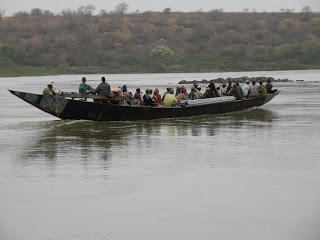
(Note that all photos shown here are a form of taxi!)

Taxis usually come in two forms: car or motorcycle, but could be a van or truck if you’re going into the bush or even a long canoe! Here in Niamey, taxis are cars. If you go to big port city of Cotonou, Benin, the best way to get weave through the congested streets is by "Zim" or motorcycle.
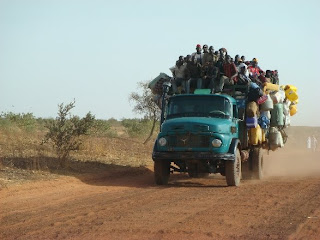
Taxis come in many states of repair or disrepair. Door handles that only work from the outside, modified door handles made out of clothes hangers, holey seats with the foam poking through, the metal skeleton of the vehicle showing, shattered windshields held together with packing tape, windows that don’t open completely or close….

The average taxi serves multiple clients at the same time (like a private run bus). “Just squeeze in. There’s always room for one more!” Babies and small kids can go on their mother’s lap or maybe even on your lap. “Hello there. What’s your name?”
Don’t expect private door to door service unless you have a hotel taxi or want to pay quadruple the price of a regular fair x two! Expect to share your taxi with at least 3 or 4 or more others.

Taxis also serve many unusual and everyday purposes! Commuting to work, going to the market, carrying your groceries home from the market, moving house, moving construction materials or agricultural supplies.

The trunk of a taxi is very versatile. It can hold anything and everything: freshly caught, fish, 50 kg bags of rice/corn/millet/potatoes/onions, pots and pans, precariously placed bowls/buckets of fermented porridge, open baskets of fragile tomatoes, small furniture, bags of manure for the garden, live chickens or goats with their feet tied, or entire legs/thighs of freshly butchered beef piled so high the trunk must be strapped down!
Some items just don’t fit in the trunk. Construction materials such as metal or wood poles may have to lay the length of the taxi and stick out of the window next to you. Once we were in a taxi where the driver hauled two HUGE truck tires on to the roof of the little old taxi. We were seriously concerned the roof would cave in on us!

Normally the taxi driver drops people off in a logical order (first come first served or whoever’s stop comes first on the way). Be prepared though to make a few detours which may bring you far away from your destination or lead you through bumpy side streets, narrow alleys and garbage dumps. The taxi driver decides where he will go and when. He may need to buy some gas along the way, or get a drink, or do a personal errand, or stop to make change for the 2000 CFA bill (worth about $5) you gave him.

Getting around town by taxi is pretty inexpensive. One average distance fare costs 200 CFA (about 50 cents). Carry plenty of little change in your purse. Don’t expect the driver to have much change for any bills no matter how small the denomination unless you happen to catch a taxi near the end of the day!
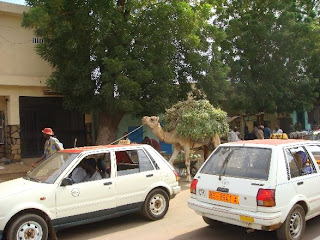
Taxi drivers are generally polite and very friendly. If they stop to buy a bottle of water, they usually buy extra and offer their passengers a bottle too. They open the door for you if you have a heavy load. Sometimes they are considerate to pull over well off the road so that you don’t have to get out into busy traffic. Generally, though, when you tell them to stop, they put on the brakes immediately. No warning to the cars behind. No gradually slowing down. No pulling over to the curb. No pulling over at a more convenient and safe location. Lesson: give the driver ample warning regarding where and when you want to get off.

Taxi etiquette: always greet the driver and EACH of the passengers when you get in. Failure to do so is very rude. Several times, I (Christine) have been reprimanded by ladies who have felt snubbed because I failed to greet them properly. Africans are very social people. They find Westerners rather antisocial in comparison. For instance, they can’t understand how Westerners can walk along a busy street without even greeting a soul or making eye contact. There will be times when the taxi driver wants to listen to radio or the other passengers are equally as tired as you, but generally it’s polite to carry on a small conversation throughout your drive. It always impresses people too if you can greet them or carry on a small conversation in one of the local languages. When it’s your stop, wave a friendly goodbye…

“Fofo. Kala han fo.” (Thank you. See you another time.)
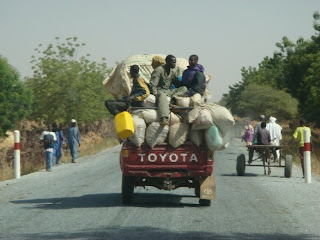
The 10 Most Indespensible Items on Long Bus Trips (in Africa)

10. A headscarf or ball cap! To keep your hair from being blown to pieces when the windows are wide open (most often on bush taxi rides).

9. A sweater or jacket! For when they turn on the AC full blast! (or for cooler evenings). It also doubles as a pillow to catch your weary head wherever you might be waiting (see item 1). In fact, a small bedroll would be rather nice! African women often just take off one of their many outer skirts/shawls, place it on the ground and lie down for a nap. You could also just bring along a small straw mat with you or your prayer rug (like many of the Muslim men).

8. Your own eating utensils AND SNACKS that your digestive system is familiar with!
Our suggestions: a pocket knife, a set of plastic cutlery, a Frisbee (works well as a plate), ziplock baggies, tea bags, milk powder (unless you like sweetened condensed milk in your tea and coffee), peanut butter, “Vache Qui Rit” cheese triangles, washed fruit, and trail mix or granola. If you forget to bring a plastic cup or bowl, be resourceful like Tim and cut off the bottom of an empty water bottle for your cup/bowl. 

7. Dental floss or tooth picks! Meat in Africa tends to be very fibrous and chewy and gets stuck in your teeth!

6. Personal entertainment for the long ride. A book, a card game, MP3 player, a pen and journal.

5. Earplugs! To block out the snoring behind you, the loud and violent movie, the roar of the broken AC fan above you, or the annoying music that is repeated over and over again because the bus driver only has 1 CD to play.

4. Hand sanitizer or travel wipes!

3. T.P. (toilet paper) or Kleenex! Have a handy supply available for pit stops at the side of the road. Don’t expect it to be provided or available, even in the nicest of restaurants.

2. Lots of bottled WATER! It’s a very useful liquid and solvent for staying hydrated in a dry, and hot climate (unless you like to stay dehydrated until the road trip is over like Tim), for washing your hands, for refilling the radiator, etc!

And the # 1 item is: PATIENCE! Be prepared for delays! From poor road conditions, detours, road construction, many stops along the way, flat tires, and other vehicle problems. You name it! The bus could even be several hours or even a day late in arriving/leaving! Very little advance warning or follow-up information is given. Customer service is rather lacking in most businesses. The response to your question regarding when they expect the bus to leave will most likely be answered with “Il faut se patienter.” (One needs to be patient.)

Of course if you’re even planning a trip within Africa, you most likely already have a sense of adventure and a good sense of humour. Bon Voyage!

Thursday, June 18, 2009

Protests in Niamey

Niger has had a number of major incidents lately, perhaps not major enough to hit Canadian news. The main items:
- The President Tandja has been asked to step down from government but he has refused and has dismissed the government. This has resulted in a lot of protest and dissension amongst the peoples. We've seen clashes and fighting on TV between government forces and local people. In the city of Dosso the protestors attacked the Governor's home and burned his car.
- the largest market in the captial city Niger caught fire and half of it burned down.

Here's part of a notice sent out by the U.S. Embassy in Niger:
"A Nigerien political consortium opposed to President Tandja's efforts to extend his mandate, known as "Tazarche" has rescheduled its nationwide public demonstration to Sunday, June 14. In Niamey, protesters are expected to gather at 8:00 a.m. at Rond Point Eglise. Additional public protests or rallies by opposition and government supporters could occur outside of Sunday's scheduled demonstration. The Islamic Council in Niger has called for a day of prayer at the Grand Mosque on the day preceding the rally, Saturday, June 13. While it is impossible to estimate the size of planned demonstrations , they could be very large. Recent events in Dosso, where a pro-Tazarche demonstration ended in violence, indicate that even demonstrations intended to be peaceful can turn confrontational and quickly escalate into violence. American citizens are urged to avoid demonstrations, exercise caution within the vicinity of any large public gathering, and stock up on food, water and other basic necessities in the event of disruption of services and deliveries of goods throughout the country. In addition, American citizens should stay current with media coverage of local events and be aware of their surroundings at all times."


I don't have photos of such things,
so here's a fun photo on a completely unrelated topic.

We recently visited the ancient capital of Niger called Zinder, in the east of the country. The city (about 150,000 people) has many winding roads. Here's Christine with the neighbourhood kids who were curiously following us...

Monday, May 18, 2009

Operation Christmas child

Christmas gifts for kids in Niger!

This blog topic is a bit late I suppose since people naturally think about Christmas gifts in December rather than May. SP is well known for its program of Operation Christmas child (OCC) - enabling people to donate their own practical Christmas gifts to children around the world in poorer countries, Niger included.
I (Tim) work in the relief and development wing of SP so I don't have much involvement in OCC but I do have some! I had the privilege several months ago to coordinate giving these gifts to children in the Bani-Bangou area located near the north border with Mali.

Pictures speak a thousand words - here's a few...

Most children in Niger have never received a Christmas gift in their entire life.


The gifts that I and my colleagues gave out would have been the first (and only) Christmas gifts they receive, since the OCC distribution has not been done in this village area before.

As you might expect, the children were thrilled and honoured to receive the gifts.

We gave out the gifts one by one by calling the names of the students (in the classroom during a regular school day), and then when the gifts were all given (in that class), we would let the kids tear open the boxes.


We were wondering if there might be a riotous commotion but in fact the kids were very well behaved (likely due mainly to the presence of the town mayor, the village chief, the school director, and a foreigner or (myself!) overseeing the event. Actually for the schools we visited, we only had enough for 10% of the children, and so we had asked/prearranged that the school administration choose the top 10% of students to receive gifts. The other 90% of children were fascinated to watch the whole gift giving event nonetheless. The children also receive a cartoon book (in French) called "the greatest gift" which talks about God's love. The village leaders actually asked if they could get a copy of this for themselves too.

The photos also show the classrooms - the pictures speak for themselves.
None of the classrooms have enough desks, often 3 - 6 kids must sit in a dilapidated desk built for 2 kids. Many kids have no desks. In fact many kids have no chairs, and many classrooms have no regular walls (they are in straw huts). We are well known in these parts as we are the main organisation helping there with basic needs - primarily nutrition and clean water and latrines, and so they were also very welcoming to receive the gifts for the kids.

Giving out gifts is great fun! Little did I know that playing with the gifts would be an immediate need for me!! This need suddenly became apparent when we noticed the kids looking at many of the gifts in bewilderment.
Not only have these kids not received gifts before, many of the toys or objects are completely unknown to them. I quickly opened the brightly coloured play dough and I sculptured a dog, or was it a camel, anyway once they saw my art work they actually figured it out, I guess it was not all that bad. Quickly I made the rounds to play with/operate toys that were mysterious to them. Good thing I worked in the Sears toy department many years ago! Even our local SP staff do not know toys that are common place for Canadians/Americans. I think play dough is a great gift to give, but the kids initially thought it was some strange food.

Fortunately many gift items require no explanation - such as pens, combs, soap, stuffed/toy animals ... These are great gift items. Actually a pen or pencil would be a gift well cherished by a child in this culture. Some gifts come in plastic boxes which are themselves great items. There were a few "embarrasing" gift items: in a African islamic culture where women dress very conservatively and most of the body and legs (most skin) are not shown in public, the skimpy blond barbie dolls in short skirts and tops were not so good.

As with any activity we do, there is plenty of organising that happens, and coordination and approvals with the local village/town authorities. Since we are already well known in this area for our development projects, it was easy to arrange in the end.
Prior to the event, I was seriously worried about problems we might encounter, especially with only having enough gifts for 1 out of very 10 children, and second that it is a "Christmas" event in a town where Christianity and Christians are completely unknown. However everyone was very well natured and easy going about it all. Even the local Imam Muslim leader participated and asked if he could hand out a few gifts which he did.

So the next time you complain about not getting enough stuff from Santa, think again! Here in Niger a few gifts to a few children has made many giggles and tiny smiling faces...

Friday, May 15, 2009

You know it's hot when...


1. the water coming out of the cold water faucet is warm enough to wash dishes!

2. you look forward to a cold shower!

3. you take 4 showers in a day!

4. you complain that the previous person in the shower took all the “cold” water!

5. you wonder if the plumber mixed the cold water and hot water pipes.

6. you’re sweating after taking a cold shower! You feel like you’re in a sauna!

7. candles melt before your eyes (and they aren’t even lit!)

8. butter from the fridge melts on a frying pan in minutes without you even lighting the burner!
9. the cat is panting like a dog!

10. the dog is digging a hole to China in the cold, damp soil of the flower garden.

Monday, February 16, 2009

Our Involvement with the Local Evangelical Church in Niamey

A brief and partial history of the church in Niger

Many people have asked us: “If Niger is predominantly a Muslim country (>95%), what kind of church presence is there in Niamey?”

Much of the evangelical Nigerien church exists in large part due to the early work of SIM missionaries (Serving in Mission, previously known as Sudan Interior Mission). SIM began working in eastern Niger in 1924 and established several schools, non-denominational churches, agricultural projects, and hospitals (of which Galmi Hospital is the most well-known). Sahel Academy International School, the ESPRIT theological seminary and Foyer Évangélique Universitaire (computer and resource centre for university students) are three more recent initiatives of SIM.

Three local denominations developed out of the national churches established by SIM: EEI, UEEPN, and EERN. The EEI church (Église Évangélique Internationale) has a stronger presence in capital city Niamey. They have one French-only congregation (the one we attend), and several other congregations that worship in local languages as well as French. The EERN church first developed in the East and is mostly attended by Hausa speakers. The UEEPN also is mostly Hausa-speaking. Each denomination has their own “flavour” or style. Most churches, for example, would have the women sitting on one side of the church (wearing head scarves) and the men on the other side. The French-language congregation we attend is mostly made up of international students and business people so the environment is more “relaxed and western” (men and women can sit together, women can wear pants and don’t need to have their head covered) although the worship is as vibrant as in any African church!

The Evangelical Baptist Mission began ministry at about the same time as SIM but in the western part of the country. The Southern Baptist Mission arrived in Niger in the early 1980’s; the Assemblies of God came to Niger in 1990. There is one Presbyterian Church that we’ve heard of in Niamey (although the Presbyterian Church is much stronger in Togo, as we noticed on our recent trip over the Christmas holidays).

Although many churches and mission agencies/groups are involved in evangelism and church planting, not all of them are necessarily establishing churches with strong denominational ties. The Christian & Missionary Alliance (C&MA) does a lot of community development and evangelism, but their goal is not to plant C&MA congregations in Niger but rather to support local Christians. This would be the same for the Christian Reform World Relief Committee. The Summer Institute of Linguistics (SIL) came in 1982 to work on Bible translation and literacy training. Other para-church mission groups working in Niger include: World Vision, Samaritan’s Purse, Campus for Christ, GBU (InterVarsity), Navigators, Youth With a Mission (JEM), Alliance Biblique, Ligue Biblique (Bible League), Child Evangelism Fellowship, Horizons Mission, Open Doors Mission, and the Norwegian Lutheran Mission (CELPA), Lutheran World Relief. This is by no means an exhaustive list of Christian NGOs or churches!

Every 3 months, the representatives of the Christian NGOs meet to pray, discuss certain issues in common, and present various projects to the group. Tim has attended a number of these meetings, and has found a great supportive community within this network of Christian NGOs.

Neighbouring countries (Nigeria and Benin) have also been instrumental in sending missionaries to Niger. Calvary Ministries is a Nigeria based agency that has an outreach to prostitutes and has a rehabilitation facility for women at risk. Agape Ministries was also started by Nigerian family a few years ago. Besides evangelism and outreach to the local community, their goal is to serve and encourage the leadership of local churches by offering conferences and motivational speakers.

In 1998, about 20 churches collaborated together to form an association of Christian churches in Niger called “Alliance des Missions et des Églises Évangéliques au Niger” (AMEEN). The regional AMEEN committees across the country unite local churches and missions for monthly prayer, fellowship and ministry outreach. AMEEN has a youth and young adults committee that brings together the youth of the various churches for sporting events, retreats, musical concerts and worship evenings. In November, Tim and I joined the young adults of our EEI congregation for a day-long “retreat” and sporting event organized by AMEEN and hosted by a local church.

There are 2 English language worship services in Niamey. The International Christian Fellowship is a church which only 2 years ago resurrected itself after a number of years without any leadership. The church serves the English-speaking African business class. It’s much smaller than it used to be (about 25-30 people each Sunday) but is an active congregation that is growing with the new leadership.

Every Sunday evening at 6pm, there is also an English worship service at Sahel Academy. This service tends to draw a large crowd of missionaries and English expats who are also quite involved in local churches on Sunday mornings. There are always friends to see and new faces at the service: long-term missionaries coming into town to do business and buy groceries, people traveling through, short-term mission teams coming and going. It’s like a big family where everybody helps out in the “family of Christ”. Various musical groups take turns leading worship (even the high school students take their turns), the little children enjoy passing around the offering baskets, visitors and travelers are welcomed and prayed for, and missionaries take turns sharing a message/sermon.

Despite constitutional religious freedom in Niger, pressures exist to make the nation more Islamic. Thankfully, Niger is a relatively safe country in which to work despite some persecution towards Christians. Please pray though for the administration and leaders of this country. Pray for men and women of integrity who are trustworthy and just and have the best interests of the country at heart.